
Opening a bottle without a corkscrew: simple methods

The key takeaway: opening a bottle without a corkscrew involves using everyday objects such as a screw, a key, or a shoe. These alternative solutions utilize leverage or inertia to loosen the neck of the bottle . The screw and pliers method is often the most reliable option for avoiding breakage of the glass.
The inability to access the contents of a bottle due to a lack of the proper tool is a common logistical constraint, but far from insurmountable. It is perfectly possible to open a bottle without a corkscrew by methodically applying certain physical principles, such as pressure or leverage, using common household objects. This guide presents the most effective alternative methods, from the inertia technique to the use of a screw, to allow wine to be served in any situation.
- Techniques that rely on strength and ingenuity
- Using everyday objects like a pro
- Alternative solutions and special cases
Techniques that rely on strength and ingenuity
You have a bottle, but the corkscrew is missing? It's a classic and annoying problem. However, you don't need to be an engineer to solve it. Physics and a little ingenuity are all it takes to save your wine tasting .
The famous shoe technique
This is the most famous method. The principle is based on inertia and the pressure exerted by the liquid on the stopper.
Remove the cap . Place the base of the bottle in the heel of a flat, cushioned shoe, such as a sneaker. Hold firmly to secure the operation .
Tap the heel of the shoe flat, with sharp blows, against a solid wall. The cork will gradually pop out under the impact.
- Remove the capsule that protects the cap.
- Insert the base of the wine bottle into a shoe with a thick sole.
- Strike the heel of the shoe, flat against a load-bearing wall .
- Stop hitting when the cork is three-quarters out and remove it by hand .
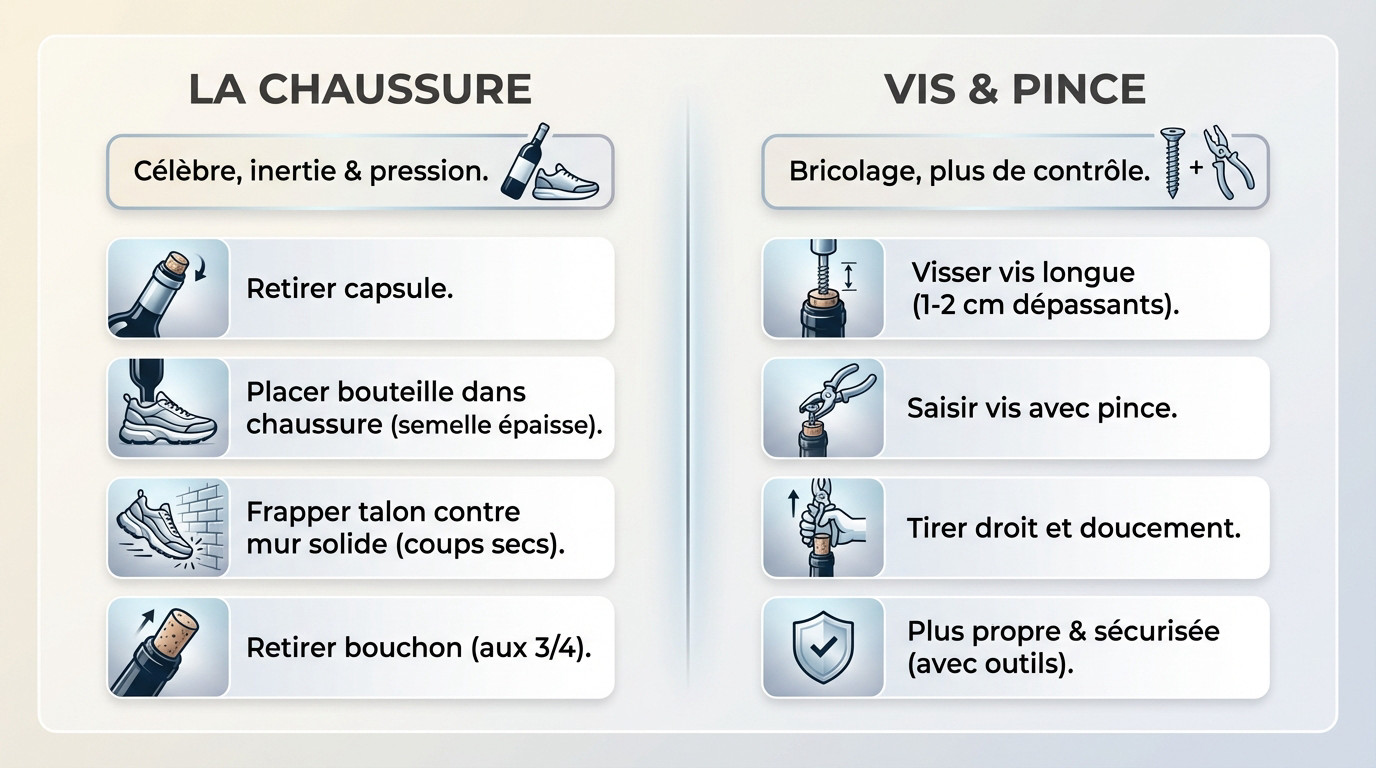
The screw and pliers method
This technique is a "DIY" version of the corkscrew. It requires a few tools, but offers more control .
Screw a fairly long screw into the center of the cap with a screwdriver, leaving about 1 to 2 cm protruding . Make sure to keep it straight.
Grip the head of the screw with pliers or the back of a hammer. Pull gently and straight to remove the plug .
Contrary to expectations, this technique is often cleaner and safer than the shoe method, provided you have the right tools on hand.
Using everyday objects like a pro
After the "brute force" methods, let's move on to solutions that require more finesse and use objects that you probably have on you.
The key or knife trick
No need for complex tools. A thin, rigid object, like a simple house or car key, will serve as an improvised lever for this operation.
Insert the key diagonally, at a 45-degree angle, as deeply as possible into the cork. Then, use leverage by turning the key upwards to gradually pull the cork out .
Using a knife remains a viable option but requires great caution . Use a solid, non-serrated blade, as the risk of injury is high if it accidentally slips.
When the cap breaks or falls out
These alternative methods are not foolproof. Sometimes the cork breaks or ends up at the bottom of the wine bottle.
Don't panic. The solution is simply to filter the liquid . A coffee filter, a fine sieve, or a clean cloth is all you need to transfer the wine cleanly.
Look on the bright side: it's the perfect opportunity to aerate the beverage. An excellent excuse to decant or aerate the wine , especially if it's young.
| Method | Required Tools | Difficulty Level | Risk Level |
|---|---|---|---|
| Shoe | Flat shoe + Solid wall | AVERAGE | Medium (bottle breakage, projection) |
| Screw & Pliers | Screw + Screwdriver + Pliers | Easy | Low (if the cork doesn't crumble) |
| Key | Solid key | Difficult | Medium (damaged cap, bent key) |
| Knife | Fixed blade knife and sturdy | Very Difficult | High (risk of serious injury) |
Alternative solutions and special cases
If you lack the tools or the plug refuses to cooperate, there are still a few cards to play, including a more... thermal approach .
The lighter technique: playing with physics
This method uses heat. The principle is simple: the expansion of the air will push the plug outwards .
Using a lighter, heat the neck of the bottle, just below the cap. Rotate the bottle to distribute the heat evenly .
The glass becomes very hot and there is a risk of breakage . Use with extreme caution.
Pushing the plug in: the last resort
Position this technique as a last resort . It's quick, but not very elegant.
Use a non-cutting, solid object (spoon handle, pen) to firmly push the cork until it falls into the wine bottle .
Be prepared to sacrifice the first glass that might get splashed. That's the price to pay for this radical but effective method.
And what about bottles without cork stoppers?
Let's clarify that the previous techniques are for cork stoppers. For screw caps or caps, the strategy is different .
For a capsule, use a hard object as a lever . For a stuck screw cap, a dry cloth for the grip or hot water may help.
- Metal capsules : Use the edge of a work surface or a sturdy wrench as a lever.
- Stuck screw caps : Use a cloth to increase grip or run them under hot water to expand the plastic.
- Sparkling wines: NEVER use these methods because of the pressure. Safety first.
Opening a bottle without the proper tool requires ingenuity and a grasp of physics . Whether using inertia, heat, or an improvised lever, caution is always necessary to avoid any accidents. These makeshift solutions allow for tasting, although a corkscrew remains the preferred tool for preserving the wine's integrity.
FAQ
How to remove a bottle cork without a corkscrew?
Several alternative methods allow you to open a bottle using everyday objects. The shoe technique uses the inertia of impacts against a wall to gradually expel the cork. Applying a heat source, such as a lighter, to the neck of the bottle causes the air to expand and pushes the cork outwards.
Other mechanical approaches exist, such as using leverage with a key or a knife inserted at an angle. Pushing the cork directly into the bottle is also a last resort, although less elegant.
How to improvise an effective extraction tool?
Reproducing the mechanism of a corkscrew is easily done with a long screw, a screwdriver, and pliers. The screw is inserted deep into the center of the cork using the screwdriver, leaving the head protruding by a few centimeters.
The pliers then grasp the visible part of the screw to apply vertical traction. This method offers precise control and reduces the risk of damaging the cork compared to percussion or pressure techniques.
What is the simplest method for opening a bottle of wine?
The technique of pushing the cork into the bottle proves to be the quickest and least technical. A thin, solid object, such as a spoon handle or a sturdy pen, is pressed firmly against the cork until it tips into the liquid.
This procedure, however, requires some caution to avoid wine splashing due to pressure. It also makes it impossible to reseal the bottle afterwards.
What everyday objects can replace a corkscrew?
A sturdy house key or a blunt knife blade can be used as a lever when inserted diagonally into the cork . A wire coat hanger, unfolded and bent into a hook shape, can also be used to pull the cork out from the bottom.
For the inertia method, a shoe with a flat, thick sole protects the bottom of the bottle . Finally, a lighter is sufficient for the thermal technique, although this requires careful handling of the hot glass.
What should you do if the cork breaks or falls into the wine?
The presence of cork fragments or the entire cork in the liquid does not necessarily affect the quality of the wine if the action is taken quickly. The solution lies in filtering the beverage through a fine-mesh sieve, a coffee filter, or a clean cloth.
Decanting the wine into a carafe allows the liquid to separate from the solid residue . This process also provides beneficial aeration to the wine before tasting.


