
Mosel and Saar: the great slopes of slate riesling
9 bottles, from the slopes of the Mosel to those of the SaarA wine name here is read in two stages: the village takes an -er suffix, the lieu-dit follows. Wehlener Sonnenuhr is the sundial slope, above Wehlen. Once you have that grammar, the valley becomes readable slope by slope.
The river carves a slate gorge between Trier and Koblenz, and every meander raises a due-south slope where riesling ripens slowly. The Saar, a tributary valley and colder, gives stricter wines that take longer to open. The two share the same layered rock, and the label always says where the bottle comes from.

Dr Loosen - Dr L Riesling Feinherb 2024
A medium-dry Mosel Riesling, lively and fruity, carried by the saline freshness of the slate slopes.

Van Volxem - Scharzhofberger Riesling Grosses Gewächs 2022
A Riesling Grosses Gewächs from the legendary Scharzhofberger, chiselled, saline and of great finesse.

Van Volxem - Bockstein Riesling Grosses Gewächs 2022
A Grosses Gewächs from the Ockfener Bockstein, broad and spicy, held taut by the lively acidity of the Saar.

Van Volxem - Wiltinger Riesling 2022
A dry Riesling from the Saar, smoky and saline, born on the volcanic slate of the Wiltingen slopes.

Van Volxem - Schonfels Riesling Grosses Gewächs 2022
A Riesling Grosses Gewächs from the Saar, juicy and concentrated, with scents of stone fruit and alpine meadows.

Trossen - Trabener Riesling Royal Süß Auslese 2020
A Moselle Auslese picked berry by berry in the Würzgarten: luminous sweetness, vibrant acidity.

Trossen - Trabener Riesling Spätlese Trocken 2022
A dry Moselle Riesling from very ripe berries: tension, finesse and a minerality that runs straight and true.
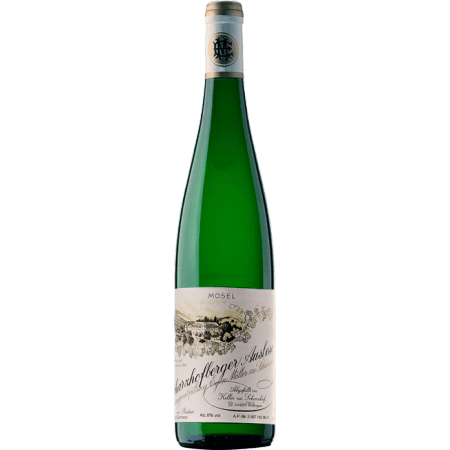
Egon Muller - Scharzhofberger Auslese 2021
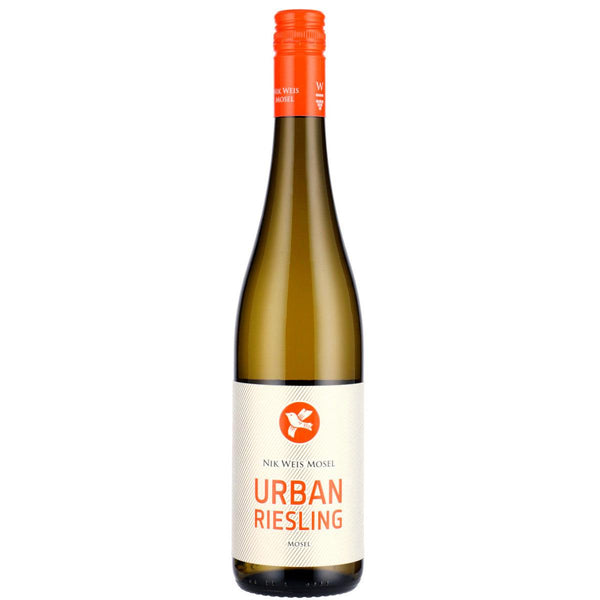
Nik Weis - Urban Riesling 2019
A pure and crisp Riesling from the Moselle Valley
The great lieux-dits of the Mosel
Every bend in the river raises a slope facing the sun, and every slope carries a name. Here are the slopes the selection runs through, from upstream to downstream, with the rock that sets them apart.
| The slope | Village and location | Soil and exposure | What it gives in the glass |
|---|---|---|---|
| Brauneberger Juffer | Brauneberg, opposite the village | Deep grey slate, due south on an even slope | Broad and sunny for the valley, yellow peach, generous finish |
| Niederberg-HeldenAxel Pauly | Lieser, just upstream of Bernkastel | Weathered grey slate, south to south-west, steep slope | Slender, lemon and white flowers, very straight |
| Bernkasteler BadstubeJoh. Jos. Prüm | Bernkastel-Kues, above the old town | Fine, fragmented grey slate, south-west | Finesse and white peach, a silky touch |
| Graacher HimmelreichJoh. Jos. Prüm | Graach, between Bernkastel and Wehlen | Thick blue slate, south to south-west | More flesh, linden and ripe apple, long finish |
| Graacher DomprobstDr. Loosen | Graach, the slope overlooking the village | Very stony blue slate, steeper slope | Tight and saline, the more structured of the two Graach slopes |
| Wehlener SonnenuhrJoh. Jos. Prüm, Dr. Loosen | Wehlen, around the sundial | Blue slate, due south, slopes of up to sixty degrees | Crystalline, lime, lace-like: the valley's benchmark |
| Zeltinger SonnenuhrJoh. Jos. Prüm | Zeltingen-Rachtig, downstream of Wehlen | Grey slate on narrow terraces, south to south-west | Straight and floral, firm, saline finish |
| Ürziger WürzgartenDr. Loosen | Ürzig, in the bend of the river | Red slate and volcanic sandstone, a south-facing amphitheatre | Spicy, muscat-like, almost exotic: the most recognisable |
| Erdener TreppchenDr. Loosen | Erden, opposite the village | Terraced red slate, south to south-west | Yellow fruit and sweet spices, rounder than its neighbours |
The Saar, a tributary valley south of Trier, carries the same slate on into colder air: around Wiltingen and the Scharzhofberg, riesling gains in austerity and asks for a few years in the cellar. There Van Volxem makes a dry Schiefer Riesling at €21 a bottle, available as a single bottle.
What the label says, word by word
A Mosel name is always written in the same order: the village, the lieu-dit, the grape variety, then the harvest and style terms. Each word answers a precise question.
| Part of the name | What it refers to | An example from the selection |
|---|---|---|
| The village ending in -er | The village of origin, turned into an adjective by the suffix -er | Wehlener comes from Wehlen, Graacher from Graach, Ürziger from Ürzig |
| The lieu-dit | The specific slope, which always follows the village name | Wehlener Sonnenuhrthe sundial of Wehlen |
| The grape variety | The grape, spelt out in full when it appears on the bottle | Weissburgunderthe German name for Pinot Blanc |
| The harvest designation | The ripeness of the grapes picked: Kabinett, Spätlese, Auslese, Beerenauslese | Erdener Treppchen Kabinettthe lightest harvest level |
| Trocken | A dry wine, whatever else the label says | Kinheimer Rosenberg Trocken GGdry and cut out for the table |
| GG | Grosses Gewächs, the cru classified by the VDP, reserved for dry wines | Wehlener Sonnenuhr Trocken GGthe dry pinnacle of the slope |
| AR | Alte Reben, old vines rooted deep in the slate | Ürziger Würzgarten Trocken GG ARold vines on red slate |
| Goldkapsel | The gold capsule, reserved for the most concentrated selection of a cuvée | Wehlener Sonnenuhr Auslese Goldkap€186 per bottle, sold individually |
The harvest terms announce the ripeness of the grapes, and the sugar scale that goes with them is set out in detail on the German wines page. To follow the grape variety from end to end, from taut dry to sweet, go to the Riesling page.
A bottle for every mood
Ways into the valley, from your first dry riesling to the gold capsule at the end of a meal.
Discover the valley's style
A dry Riesling from Lieser, lemon and wet stone, raised on grey slate. The most faithful way into the Mosel taste.
Axel Pauly Generations Riesling 2022 · €18.60 per bottle, by the case of 6Taste the red slate
Ürzig's volcanic slope gives a spicy, almost exotic Riesling, light in alcohol and lifted by lively acidity.
Dr Loosen Urziger Wurzgarten Kabinett 2024 · €23.80 per bottle, by the case of 6A dry wine from a great slope
Old vines on the blue slate of Wehlen, fermented in foudre: dry riesling in its deepest form.
Dr Loosen Wehlener Sonnenuhr Trocken GG AR 2022 · €55 per bottle, in a set of 2Head over to the Saar
A neighbouring valley, colder air, stricter wines. A taut, saline dry wine, cut out for oysters and seafood platters.
Van Volxem Schiefer Riesling 2022 · €21 per bottle, sold individuallyUnderstand Mosel lightness
Eight percent alcohol, a hint of sugar and an acidity that refreshes the palate: the signature of Wehlen's most famous estate.
Joh Jos Prüm Graacher Himmelreich Kabinett 2023 · €55.80 per bottle, in a set of 2End the meal gently
Botrytised berries sorted one by one, honey and candied fruit, held together by vibrant acidity. The companion to Roquefort.
Dr Loosen Beerenauslese 2018 · €40.80 per bottle, in a set of 3Give a bottle for ageing
The gold capsule from the sundial slope, with ageing potential counted in decades. The gift for the well-informed.
Joh Jos Prüm Wehlener Sonnenuhr Auslese Goldkap 2018 · €186 per bottle, sold individuallyFollow a Bernkastel house
From light Kabinett to old-vine Grosses Gewächs, the estate that put the great Mosel slopes back in the spotlight.
Section page · Dr. Loosen
Blue slate, red slate
The rock changes colour along the way, and the wine follows. Around Wehlen, Graach and Zeltingen, Devonian blue slate gives fine, taut wines, almost like lace, with that note of lime that made the valley's reputation. A few kilometres downstream, at Ürzig and Erden, an intrusion of red sandstone and volcanic rock warms the soil: there the riesling turns spicy, muscat-scented, broader on the palate.
The Saar adds a third register. This tributary valley, higher and cooler, ripens its grapes later: the wines are born austere, seemingly slight, and open out their depth after a few years in the cellar.
How do you choose
On this shelf we taste before we list, and we look at two things: the precision of the fruit and how the saline finish holds. A prestigious slope name counts for less than what is still there ten seconds after the sip. For the rest, we follow the estates that harvest by hand on the steepest slopes.
The Wine Wanderer Team
What we are asked about the Mosel
Why are these bottles mostly sold in sets or by the case?
The Mosel estates we follow ship their cuvées in full cases, and we keep that format to hold the price down. The price shown on each listing is the price per bottle, and the sales format appears right next to it. A few wines are still offered as single bottles, notably from Joh. Jos. Prüm and Van Volxem.
How do you read a German wine name?
The first word is the village, recognisable by its -er suffix: Wehlener for Wehlen, Graacher for Graach. The second is the lieu-dit, that is to say the precise slope. Then come the grape variety, followed by the harvest and style terms. The label-reading table goes through each of these elements with an example.
Is a Mosel riesling always sweet?
The word to look for is Trocken, which guarantees a dry wine whatever else the label says. Used on their own, the terms Kabinett, Spätlese and Auslese announce on the contrary a wine that is increasingly sweet, its sugar carried by a lively acidity. Most of the valley today makes dry wine.
What is the difference between blue slate and red slate?
Blue slate dominates around Wehlen, Graach and Zeltingen: it gives fine, taut wines marked by lime and wet stone. Red slate appears at Ürzig and Erden, mixed with sandstone and volcanic rock, and delivers spicier, broader rieslings with very ripe yellow fruit.
How long do these Rieslings keep?
Far longer than most whites, because the acidity and the sugar protect the wine. A Kabinett holds for ten years, an Auslese for several decades. Expect a closed phase around the fifth year, then a reopening on honey, lime blossom and that petrol note that marks a riesling come of age.
How does the Saar differ from the Mosel?
The Saar is a tributary valley south of Trier, higher up and more exposed to the cold. The grapes ripen later, the acidity stays livelier, and the wines seem austere in their youth before gaining depth. Their admirers actually prefer them after a few years in the cellar.
What does Sonnenuhr mean on a label?
The word means a sundial. Growers built several of them halfway up the slopes to give the harvest teams the time, and the best known of them looks down over Wehlen. Two slopes in the selection carry the name, Wehlener Sonnenuhr and Zeltinger Sonnenuhr, always preceded by the village to tell them apart.
Which slope should you choose for a first purchase?
Start with a wine from Lieser or Bernkastel, more affordable than the Wehlen crus and already very representative. Axel Pauly's dry Generations Riesling, at €18.60 a bottle by the case of 6, lays out the grammar of the valley in a single glass. A second bottle in Kabinett then shows what the sugar brings.
At what temperature should these wines be served?
Count on ten to twelve degrees for a dry riesling, and a little cooler, around eight degrees, for a Kabinett, a Spätlese or an Auslese whose sugar gains from being tightened up. Take the bottle out of the fridge a quarter of an hour before serving, and choose a fairly wide glass to let the wine breathe.
Which dishes go with a Mosel riesling?
A dry wine calls for the rich and the salty: oysters, trout with beurre blanc, smoked salmon, fresh goat cheese. A Kabinett stands up to spicy cooking, Thai or mild Indian. The Auslese and the Beerenauslese are waiting for foie gras, Roquefort and yellow-fruit desserts.