
When and how to prune vines: the complete guide

Key takeaway: Winter pruning directs the vine's vigor towards fruit production . By working during the dormant period, this operation optimizes aroma concentration and reduces the risk of disease . Gentle pruning, respecting sap flow, ensures the vine's longevity and superior quality in future harvests.
The fear of damaging the wood with an awkward cut often paralyzes gardeners, even though knowing when and how to prune vines remains the key to obtaining flavorful fruit . This guide explains the ideal dormancy periods and specific pruning methods to direct the plant's vigor towards the grape cluster. Proper mastery of these techniques preserves the vine's reserves over the long term and promotes even ripening of the berries.
- Why on earth would anyone bother with pruning shears on their vine?
- The tailor's calendar: finding the perfect window of opportunity
- The amateur winemaker's arsenal: your allies for a clean cut
- Life-saving techniques: how to prune without destroying
- Beginner mistakes to absolutely avoid
Why on earth would anyone bother with pruning shears on their vine?
For quality grapes, not a jungle of leaves
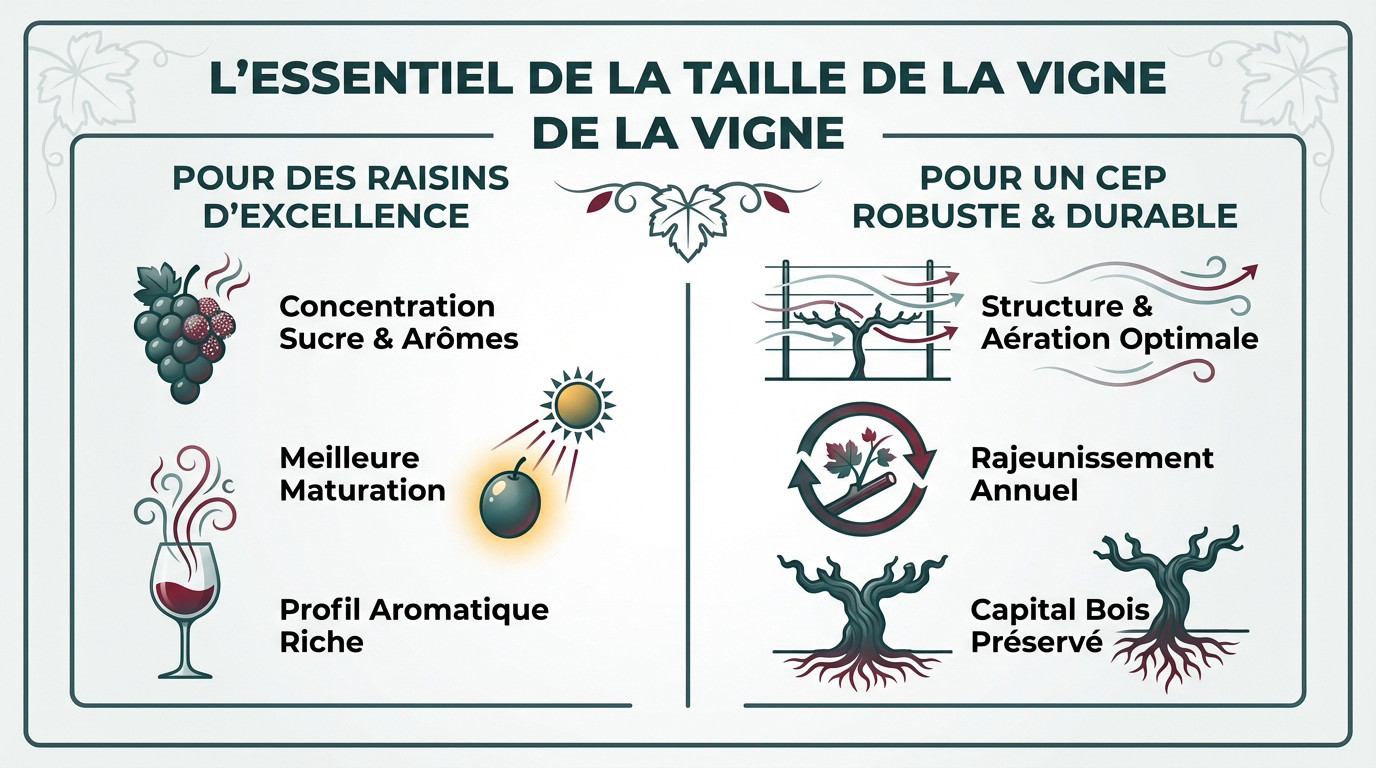
If you let nature take its course, your vine will become a monster of wood and leaves. It will waste its energy everywhere except on fruit. The goal is not to obtain invasive vines, but grapes concentrated in sugar and aroma .
Pruning limits the number of grape bunches. Fewer fruits mean more resources for each one. This is the secret to ensuring better ripening and therefore superior grape quality .
This pruning influences the aromatic profile of the wine . Canopy management modifies the sunlight reaching the berries and the final character, regardless of the grape variety chosen.
Controlling vigor for the vine's longevity
Pruning also guides the plant's growth. It provides a solid framework. This facilitates future work and ensures optimal aeration, which greatly reduces the risk of diseases like mildew.
Think of winter pruning as a "reset". It allows you to remove dead or diseased wood and rejuvenate the plant. It's a concrete investment in its longevity .
A well-pruned vine will age better , that's a fact. You preserve its wood capital for decades of production, instead of depleting it in a few years of uncontrolled growth.
The tailor's calendar: finding the perfect window of opportunity
Now that you know why this pruning is vital, the million-dollar question is: when to act ? Timing is everything, and getting it wrong can be costly.
The dormancy period, the only real time
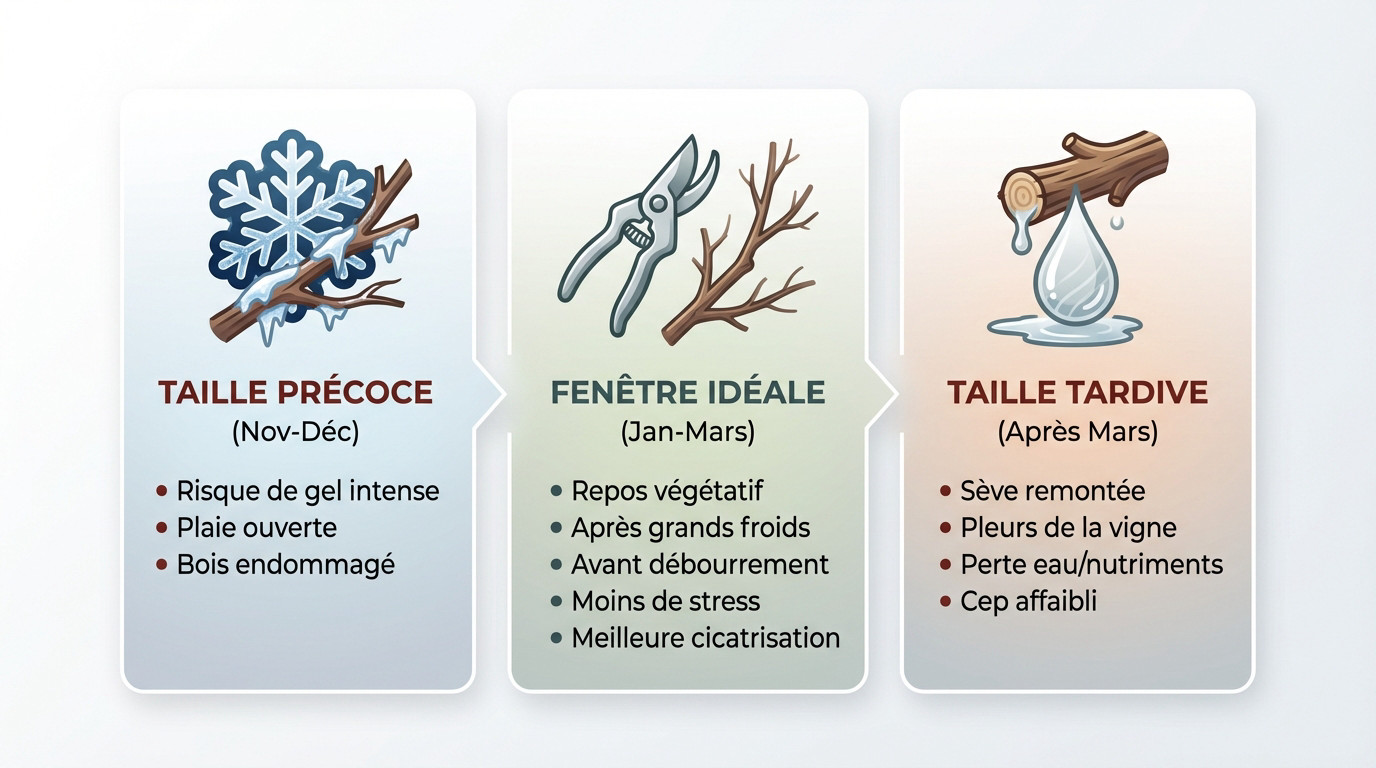
The principle is simple: prune when the vine is dormant . This period of vegetative rest begins after the leaves have fallen. The ideal window is from January to March, once the hard frosts have passed, but absolutely before bud break. Basically, act when nature is at rest: that's when the plant will suffer the least.
The "weeping" of the vine: a sign that it's too late
If you prune while the sap is rising, liquid will flow from the cuts: this is the vine's "weeping." It's not a disaster, but it's a sign of delayed growth. This seepage weakens the vine, causing it to lose water and precious nutrients, a stress that can leave it vulnerable for the season .
The frost trap: don't prune too early
Pruning in November is tempting, but risky in cold regions. A fresh wound is an entry point for intense frost , damaging the wood deeply.
Waiting until the end of winter allows the vine to heal better. Late pruning, just before spring awakening, is often safer than pruning too early, which exposes the plant to the worst of frost.
The amateur winemaker's arsenal: your allies for a clean cut
Is the timing right? Perfect. Now let's talk about equipment. No need to spend a fortune, but keep in mind that quality tools, well-maintained, make all the difference between a masterpiece and a vegetable butchery.
The pruning shears, your best friend
Forget that old rusty pair of pruning shears gathering dust in the garage. Your success depends on using bypass pruners for the living or anvil pruners for the dead. The absolute must? They must be razor-sharp and disinfected .
A clean cut heals quickly and well. Conversely, a crushed or jagged wound literally invites fungi and diseases to take hold . It's as simple and brutal as that.
If you're managing an entire plot of land, an electric tool saves your wrists. But for one or two vines in the garden, a good manual tool does the job perfectly well without any frills.
Saw and loppers for tough situations
Pruning shears quickly reach their physical limits. For shoots exceeding 2 or 3 cm in diameter, or for removing old wood, a small pruning saw becomes essential . Opt for a thin, curved blade for surgical precision.
The lopper is an interesting alternative. Thanks to its long handles, it offers powerful leverage for medium-sized branches. It's the ideal compromise between pruning shears and a saw .
- A well-sharpened pair of secateurs : handles 90% of common cuts.
- A small pruning saw : essential for old wood or large sections.
- 70% alcohol: to disinfect the blades between each vine.
- Protective gloves : to protect your hands from scratches and blisters.
Life-saving techniques: how to prune without destroying
With the right equipment and timing, all that remains is to know where to cut . Don't panic, the basic principles are logical.
The main principles: Guyot, Cordon and Gobelet explained
It's important to understand the three pruning methods used to structure the vine according to the climate. For further information, this practical guide on vine pruning is an excellent resource.
| Size type | Description | Ideal for... |
|---|---|---|
| Guyot pruning | One or two wands (6-10 eyes) and recall runners. | Most of the vineyards are very productive. |
| Royat Cordon | Horizontal frame with two-bud spurs distributed across it. | Trellised vines, mechanization, quality. |
| Cup Size | No trellising, 3 to 5 short arms starting from the trunk. | Hot and windy regions, manual maintenance. |
Gentle pruning: think like sap so as not to wound
Golden rule: sap is a highway, avoid blockages. A clean cut on old wood creates a cone of desiccation that blocks the flow. Adopt gentle pruning: always leave a one-centimeter stub . Necrosis will concentrate on this dead wood, sparing the living vessels.
Grapevine vs. ornamental vine: two objectives, two sizes
Virginia creeper is not pruned like a grapevine. For ornamental purposes, the goal is to control its vigor to cover a certain area. For a table grapevine, each pruning is aimed at the future harvest by selecting fruiting canes. One is for aesthetics, the other for productivity .
Beginner mistakes to absolutely avoid
You have the theory, but the field doesn't forgive improvisation. Here are the classic pitfalls that often ruin the efforts of novices.
Cutting old wood down to the ground: an open invitation to disease
This is a fatal mistake. Sawing flush with the trunk creates an irreversible wound, a veritable invitation to wood diseases like esca . Never do that.
The plant's survival takes precedence over aesthetics .
Thinking about the long-term health of your vine is more important than having a "clean" cut. That extra centimeter of wood, the stub, is your vine's life insurance.
Leaving too much wood or not enough: finding the right balance
A timid hand guarantees dense vegetation but poor quality grapes . The vine exhausts itself in the foliage and the bunches struggle to ripen.
Conversely, a drastic pruning risks destroying the entire harvest. Balance is key : observe the vigor of your vine to adjust your approach.
Forgetting to clean your tools: contamination guaranteed
Moving from an infected vine to a healthy one without disinfecting is like operating with a dirty scalpel. You are actively spreading the problems throughout your plot.
Beyond strict hygiene, other oversights are costly. Here are the major pitfalls to absolutely avoid :
- Mistake 1: Pruning in rainy weather (promotes fungi).
- Mistake 2: Leaving cut vine shoots on the ground (reservoirs of diseases).
- Mistake 3: Making multiple small cuts instead of one single, clean cut.
- Mistake 4: Ignoring the vigor of the vine (a weak plant should be pruned short).
Pruning the vines is a fundamental step in ensuring the vine's longevity and the quality of the grapes . Mastering this technique, respecting the dormant period and using appropriate tools, allows for balancing the plant's vigor . Careful intervention thus guarantees optimal future harvests .
FAQ
What is the ideal time to prune vines?
The optimal time to intervene is during the plant's dormant period , once the leaves have fallen and the sap has descended. This dormancy phase generally extends from January to March, taking care to avoid periods of severe freezing temperatures.
How do you prune table grapes?
Table grape pruning prioritizes fruit quality over foliage development. It involves selecting fruiting canes and limiting the number of buds, or "eyes," to concentrate the vine's energy on future grape clusters. Methods such as Guyot and Cordon pruning are often preferred for structuring production.
What are the key steps in winter pruning?
The process begins by removing dead wood and excess shoots using clean, disinfected pruning shears. Next, the selected branches are shortened, leaving a small stub of wood above the last remaining bud. This technique of not cutting back completely prevents the living tissue from drying out and promotes healthy healing .
Is it possible to prune the vine as early as October?
Pruning in October is considered premature because the vine has not yet fully entered dormancy. The potential presence of leaves and residual sap flow expose pruning wounds to the first frosts. It is best to wait until the plant is completely dormant to avoid weakening the wood.
What are the specific characteristics of pruning a vine on a trellis?
The pruning of a grapevine trained on a trellis varies depending on whether the goal is ornamental or productive. For simple ground cover, pruning primarily serves to guide the shoots on the support and control their growth. If grape production is desired, more rigorous pruning is necessary to allow air circulation and ensure adequate sunlight for the fruit.
Does pruning in March present any risks?
Pruning in March is a common practice, known as late pruning, which often helps avoid damage from spring frosts by delaying bud break. The main risk is the appearance of "weeping," a flow of sap at the cuts, which signals the plant's renewed activity but is generally harmless for a vigorous vine.
Which technique promotes the production of large bunches of grapes?
To obtain larger, sweeter bunches, load management is essential. Short pruning, which reduces the number of buds, limits the total quantity of fruit but allows the vine to allocate more resources to each remaining bunch. This balance prevents the vine from becoming exhausted and ensures better ripening .
Is leaf removal necessary in addition to pruning?
Leaf removal is a separate operation from winter pruning, carried out during the vegetative growth period. It consists of removing some leaves around the grape bunches to improve their aeration and sun exposure . Although optional, this step complements the initial pruning work to optimize the health and quality of the harvest.


